
Digital advertising is easy to measure when the customer journey ends online. Marketers can track clicks, form fills, purchases and other conversions.
But what happens when someone sees a digital ad and then walks into a physical store?
For retailers, brands and other businesses with brick-and-mortar locations, online metrics only tell part of the story. Drive to Store advertising connects digital ad exposure with real-world store visits. That gives marketers a clearer picture of how their campaigns influence offline behavior.
Here's how a Drive to Store campaign works, from geographic targeting and ad delivery to measuring store visits and reporting on results.
What is Drive to Store advertising?
Drive to Store advertising is a digital marketing strategy that encourages consumers to visit a physical location. It also shows marketers how their advertising affects store traffic.
Campaigns combine geographic targeting with audience criteria to reach consumers who matter to the brand and who live or shop within a realistic distance of participating locations.
Store visit measurement then connects paid media impressions to visits at those locations. Marketers can judge performance by a real-world outcome, the store visit, instead of relying only on impressions and clicks.
How does a Drive to Store campaign work?
The technology behind Drive to Store measurement is sophisticated, but the customer journey comes down to four steps.
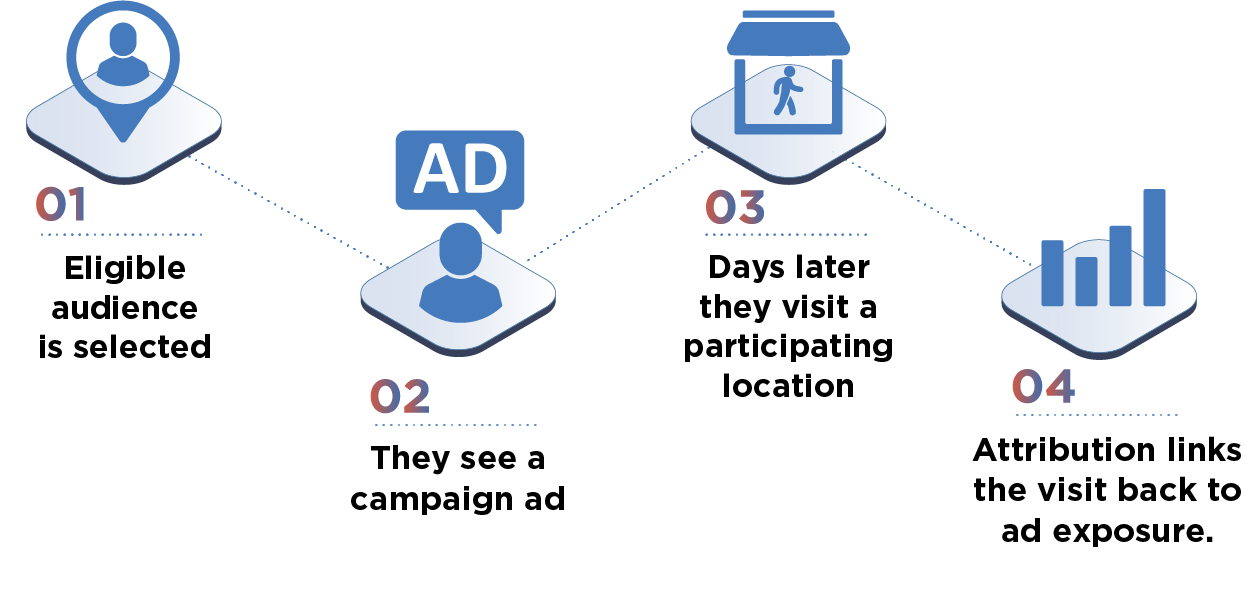
1. Define and reach the right audience:
A campaign starts by choosing the consumers the advertiser wants to reach. Audience criteria are combined with geographic targeting so media focuses on relevant consumers in important markets or trade areas.
2. Deliver ads across digital media
Consumers in the audience see campaign ads across digital channels, including display, online video, Connected TV (CTV), OTT, audio and digital out-of-home (DOOH). For example, someone might see an ad while streaming TV at home and visit a participating store a few days later.
3. Measure visits to participating stores
After seeing the campaign, some consumers visit a participating store. Each store is a defined location used to measure visits, separate from the wider area where ads are delivered.
4. Connect store visits to campaign exposure
Attribution links those store visits back to earlier ad exposure. Marketers can then see how their digital advertising influences physical store traffic.
How geo-targeting supports Drive to Store campaigns
Geographic targeting focuses media on consumers in places where an in-person visit is realistic.
For example, a retailer could set up targeting areas around neighborhoods or trade areas near its participating stores. People in those areas can then be reached with advertising.
The area where ads reach people is different from the store itself. Targeting areas decide where the campaign can reach consumers. The participating store is the location used to measure visits.
The targeting strategy depends on the campaign, but the principle stays the same: focus advertising on relevant audiences in the places that make sense for the business goal.
How are store visits measured?
Several capabilities work together behind a Drive to Store campaign to connect digital advertising with activity in physical stores.
When a consumer is served an ad, the campaign records that exposure. Store visit measurement then identifies visits to participating locations. Attribution connects those visits back to campaign exposure, so marketers can see which visits their advertising drove.
Together, these capabilities close the gap between what happens on a screen and what happens in a store.
What can marketers learn from Drive to Store measurement?
Drive to Store measurement connects digital ad exposure with offline store activity, which gives a more complete view of campaign performance.
This closed-loop reporting shows how media spend turns into real-world outcomes, not just impressions, clicks and other online activity. Depending on the campaign and the integrations available, measurement can go beyond store visits to in-store sales.
With these insights, marketers can:
-
See which audiences, markets and campaigns drive the most visits
-
Compare performance by store, region or nationally
-
Evaluate cost per visit
- Measure in-store sales and cost per sale when sales data is available
The goal isn't just another marketing metric. It's better information for optimizing campaigns and deciding where budget should go.
What about consumer privacy?
Location-based advertising and measurement make responsible data practices especially important.
Drive to Store solutions should handle data in privacy-conscious ways and follow all applicable privacy requirements. Marketers should understand what data their provider uses, how it's processed and how campaign results are reported.
For a deeper look at the technology and considerations behind these solutions, read What Are Drive to Store Solutions? ➡️
From digital impressions to real-world impact
For brands with physical locations, a click isn't always the final destination.
A consumer can see an ad, never click it and still visit a store later. When measurement stops at online activity, marketers miss an important part of what their advertising does.
Drive to Store advertising closes that gap by connecting digital exposure to store visits. With store-level reporting, marketers can see which retailers, regions and campaigns drive the strongest results.
That gives a more complete picture of performance and better information for deciding what to do next.
See how Drive to Store could work for your brand
Want to understand how your digital campaigns are influencing visits to your physical locations? Talk to a Cybba expert about Drive to Store.